
Choosing between Invisalign and braces in Dubai? Here’s what the clinical research actually shows about comfort, treatment time, effectiveness, and long-term results.
If you’ve started researching teeth straightening in Dubai, you’ve probably landed on the same fork in the road as everyone else: Invisalign or braces? Both are backed by decades of orthodontic research, both work — but they don’t work the same way, and the research shows real differences in comfort, speed, and results depending on your case.
This guide walks through what the clinical evidence actually says, so you can go into your Dubai consultation asking the right questions instead of guessing.

How Braces and Clear Aligners Actually Move Teeth
This is the part most Dubai clinics skip over, and it’s the most important one.
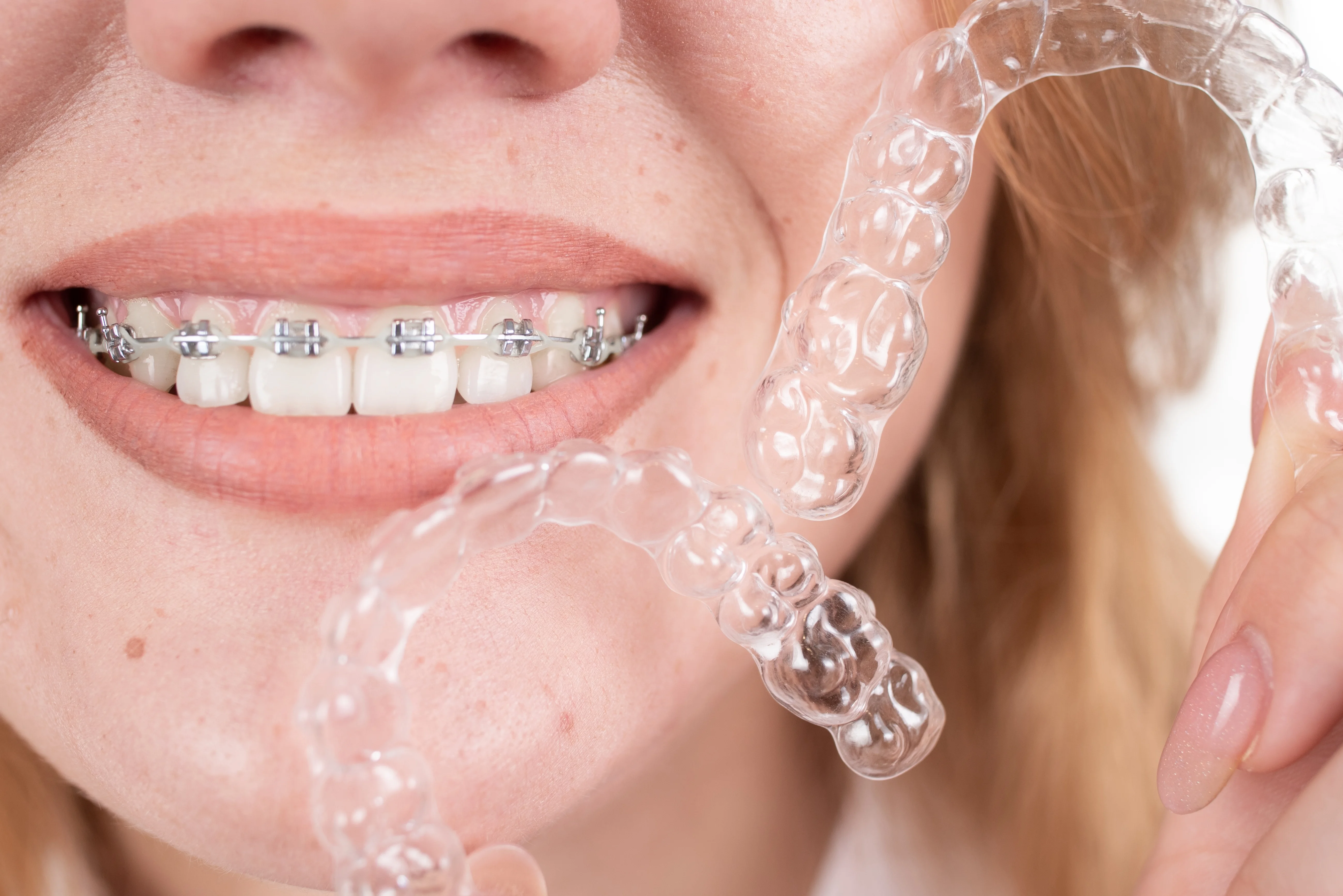
Traditional braces use brackets and wires that apply a continuous pull force on the tooth, day and night, from a fixed point.
Clear aligners work completely differently. Each tray applies a push force across the whole visible surface of the tooth — front, back, and biting edge — and that force resets every two weeks when you switch trays, so it’s intermittent rather than constant. Researchers describe this as a fundamentally different biomechanical system, not just a cosmetic alternative to wires. Upadhyay & Arqub, J World Fed Orthod, 2022
This distinction matters more than most patients realize: a dentist or orthodontist who is excellent with braces is not automatically equally skilled with clear aligners. Because the forces, the treatment planning software, and the way teeth respond are genuinely different, aligner treatment requires its own specific training and case experience — separate from years of experience with wires and brackets. Research on orthodontists’ knowledge of clear aligner therapy has found that predictability is often overestimated by practitioners with limited hands-on aligner experience, and has called for dedicated aligner-specific training and troubleshooting education, distinct from general orthodontic training. PMC, Sichuan University study
Read our guide to clear aligners and braces comparison.
So when you’re comparing clinics in Dubai, “orthodontist-led” isn’t the full question — ask specifically how much clear aligner case experience your treating doctor has, separate from their braces experience.
Invisalign vs Braces: Side-by-Side Comparison
| Factor | Traditional Braces | Invisalign / Clear Aligners |
|---|---|---|
| Force type | Continuous pull force from fixed brackets | Intermittent push force, resets every tray change |
| Visibility | Visible metal brackets and wires | Clear, close to invisible |
| Removable | No — fixed to teeth throughout treatment | Yes — removed for eating, brushing, and social occasions |
| Diet restrictions | Yes — no sticky, hard, or crunchy foods | None — trays come out to eat |
| Oral hygiene during treatment | Harder to clean around brackets and wires | Easier — some research links this to a healthier oral microbiome during treatment study |
| Effectiveness on complex cases | Generally stronger for severe crowding, rotation, and cases needing precise root torque | Effective for mild-to-moderate cases; some studies found a clinically significant shortfall in achieving planned torque above 10° in certain tooth movements study |
| Treatment duration (extraction cases) | Tends to be shorter | Tends to take longer for the same complexity study |
| Mid-course corrections | Less common | Reported in an estimated 70–80% of aligner cases, according to clinician-reported data source |
| Patient comfort | More initial soreness after each adjustment | Reported as more comfortable, especially early in treatment, due to lower force levels and no metal irritation study |
| Patient satisfaction | 76% satisfaction rate in a 200-patient comparative study | 92% satisfaction rate in the same study |
| Periodontal (gum) health | More prone to plaque buildup around fixed hardware | Some evidence favors aligners for periodontal health, though overall evidence quality is rated low-to-moderate study |
What This Means for Complex vs Simple Cases
The research is fairly consistent on one point: for mild to moderate crowding, spacing, or bite issues, clear aligners in Dubai can achieve results that are clinically comparable to braces, with several studies finding no significant difference in overall tooth movement between the two. ScienceDirect, 2024
For complex cases — significant rotation, extraction-based treatment, or cases needing precise torque control — the evidence currently favors braces for achieving predictable outcomes in a shorter timeframe. This doesn’t mean aligners can’t treat complex cases; it means they require a more experienced hand and, often, a longer treatment window, sometimes shifting into hybrid treatment (a combination of aligners and braces) partway through. Jaber, Hajeer & Sultan, Cureus, 2023
Daily Life With Each Option in Dubai
Dubai’s lifestyle — frequent social events, business dinners, travel, and a climate where you’re often eating and drinking on the go — makes the “removable vs fixed” difference more than a technical detail.
- Braces: fixed in place 24/7. No decisions to make, no discipline required, but sticky dates, karak-soaked sweets, and certain crunchy snacks are off the table for the duration of treatment.
- Invisalign in Dubai: total flexibility around iftars, weddings, and work travel — you remove the trays and eat normally — but this only works if you’re honest with yourself about wearing them 20–22 hours a day. Compliance is the single biggest variable in aligner success.
A real ProAlign case: a 20-year-old patient came in with severe crowding and was treated with ProAlign aligners for 13 months.

So Which Should You Choose?
There’s no single right answer — the research supports both options, for different situations:
- Choose braces if: your case involves significant crowding, rotation, or a bite issue that needs precise, predictable correction, or you don’t want to rely on your own discipline to wear something removable.
- Choose Invisalign if: your case is mild to moderate, you value discretion and flexibility, and you’re confident you’ll keep to the 20–22 hour daily wear.
The only reliable way to know which category you fall into is a proper clinical assessment — a digital scan, a bite analysis, and a treatment plan built around your actual teeth, not a generic recommendation. You can review the clinic location and arrange an assessment through our Dubai clinic page.
Why This Matters at ProAlign
At ProAlign, treatment plans for clear aligners are built by our in-house orthodontist team — and critically, by clinicians with specific clear aligner case experience, not just general orthodontic credentials. Given how differently aligners move teeth compared to braces, we treat that distinction as a real clinical requirement, not a marketing detail.
Ready to find out which option fits your case? Book a consultation with ProAlign in Dubai and get a treatment plan built around a digital scan of your own teeth — not a one-size-fits-all recommendation.
Frequently Asked Questions
Is Invisalign as effective as braces?
For mild to moderate cases, research shows clear aligners can achieve results comparable to braces. For complex cases involving significant rotation or precise torque control, braces currently have stronger clinical evidence for predictable, faster outcomes. study
Is every orthodontist equally skilled with clear aligners?
No. Braces and clear aligners move teeth using different biomechanical forces, so treating with aligners well requires its own specific training and case experience — not just general orthodontic credentials. study
How long does clear aligner treatment take in Dubai?
Most cases run 6 to 18 months, similar to braces, though more complex cases can take longer with aligners and may shift into hybrid treatment (aligners plus braces) partway through.
Do clear aligners need mid-course corrections?
Often, yes. Clinician-reported data suggests 70–80% of aligner cases need some form of mid-course correction, compared to less commonly with braces. source
Are clear aligners more comfortable than braces?
Generally yes, especially early in treatment — aligners apply lower forces and have no metal brackets or wires to irritate the cheeks and gums. study
Can I eat normally with clear aligners in Dubai?
Yes. Aligners are removed before eating and drinking anything other than water, so there are no food restrictions — a common advantage for Dubai’s social and dining culture.
Is Invisalign or braces better for gum health?
Some evidence favors aligners for periodontal health, largely because they’re easier to clean around, though the overall quality of this evidence is still rated low-to-moderate. study
What should I ask a Dubai clinic before choosing Invisalign?
Ask specifically how much clear aligner case experience the treating doctor has, separate from their experience with braces — the two require different skill sets.
References
- Upadhyay M, Arqub SA. Biomechanics of clear aligners: hidden truths & first principles. J World Fed Orthod. 2022.
- Orthodontic Practitioners’ Knowledge and Education Demand on Clear Aligner Therapy. PMC, West China Hospital of Stomatology, Sichuan University.
- España-Pamplona P, et al. Changes in the Oral Microbiota with the Use of Aligners vs. Braces: A Systematic Review. J Clin Med. 2024.
- Rajan N, Weir T, Meade MJ. Efficacy of planned moderate to severe torque changes in maxillary central incisors with the Invisalign appliance. Am J Orthod Dentofacial Orthop. 2024.
- Jaber ST, Hajeer MY, Sultan K. Treatment Effectiveness of Clear Aligners in Correcting Complicated and Severe Malocclusion Cases Compared to Fixed Orthodontic Appliances: A Systematic Review. Cureus. 2023.
- Effectiveness of Clear Orthodontic Aligners in Correcting Malocclusions: A Systematic Review and Meta-Analysis. ScienceDirect. 2024.
- The Differential Impact of Clear Aligners and Fixed Orthodontic Appliances on Periodontal Health: A Systematic Review. PMC. 2024.
- Comparative patient satisfaction study, clear aligners vs traditional braces. PMC. 2024.
- Clear Aligners vs Traditional Braces (evidence review). Decisions in Dentistry. 2025.
Adults considering discreet orthodontic treatment can learn more about clear aligners for adults in Dubai.